
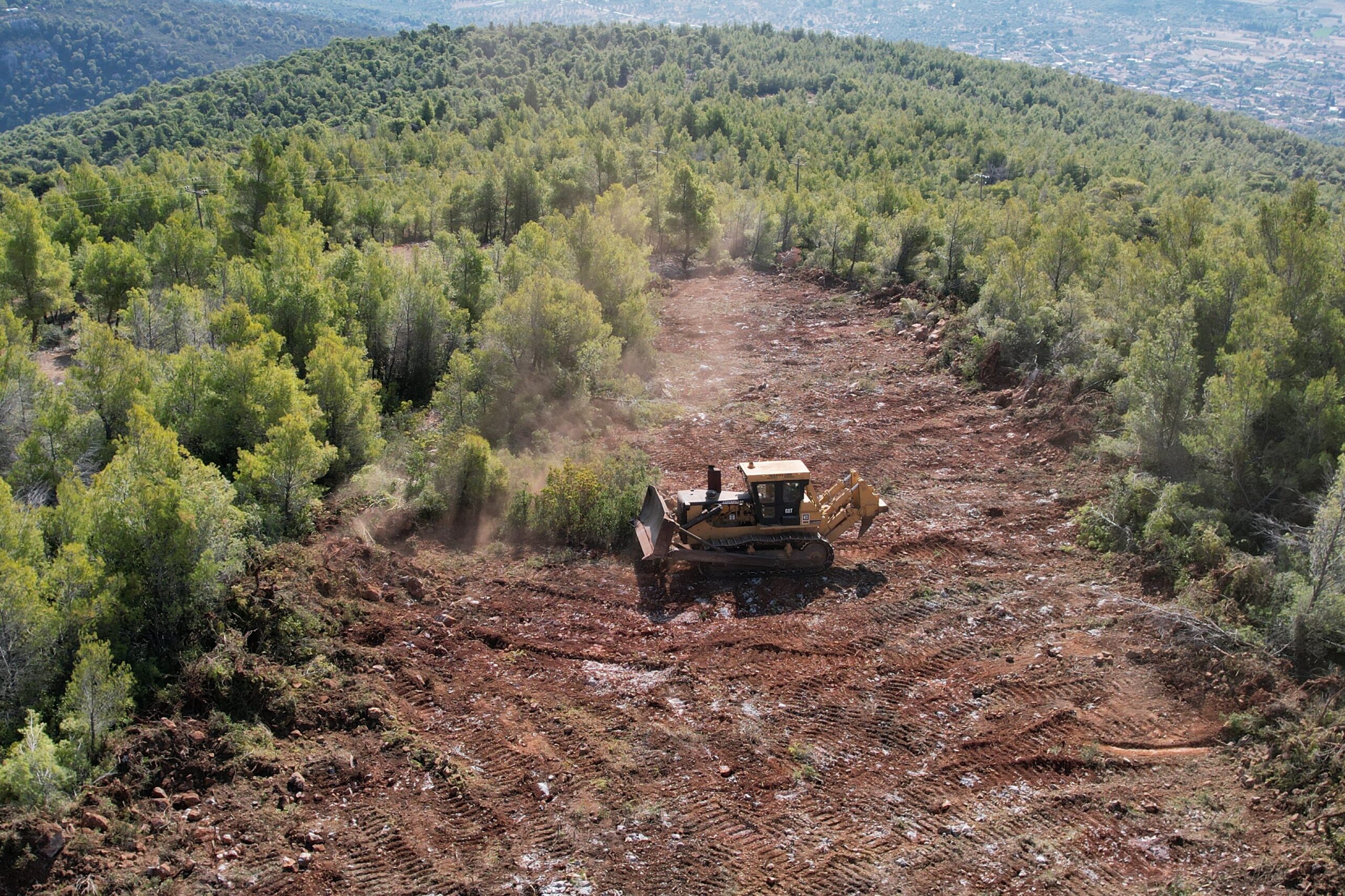
Firebreaks are one of the most critical and visible tools of fire protection, playing a key role in the prevention and response to forest fires. A firebreak is essentially a strip of land where vegetation (trees, shrubs, ground cover) has been managed or completely removed in order to stop the spread of fire.
Firebreaks are mainly classified into two basic types:
- Clear (or bare) firebreaks: These are fully cleared strips of land where all vegetation has been removed down to the mineral soil. They are particularly effective in stopping surface fires.
- Shaded firebreaks: In these zones, tree cover is retained, but the understory (shrubs, grasses) and the lower tree branches are completely removed. The goal is to prevent the fire from spreading from the ground to the tree canopies, a phenomenon that leads to high-intensity and harder-to-control wildfires.
The role of firebreaks is multidimensional and falls within the broader context of pre-suppression, i.e., actions taken before a fire occurs to facilitate its suppression.

Specifically, firebreaks:
- Slow the spread of fire: They serve as the primary barrier to the fire’s path. By reducing the available fuel, they interrupt its transmission rate, giving firefighters valuable time to intervene.
- Provide safe access: They act as pathways for firefighting vehicles, allowing them to approach the fire front more safely and quickly.
- Act as lines of defense: Firefighters can use them as a base to install water hoses and create a defensive line to contain the fire or guide it to safer areas. In some cases, firebreaks are used for the “backfiring” tactic, where a controlled burn is carried out in front of the main fire to deprive it of fuel.
- Protect settlements and infrastructure: The creation of perimeter firebreaks around cities, villages, and other infrastructure (such as military camps or industrial facilities) is vital for protecting them from direct flame contact.
The choice of type, width, and location of a firebreak depends on factors such as the area’s topography, vegetation type, prevailing winds, and proximity to settlements.
In conclusion, firebreaks are an indispensable tool of proactive forest protection. Their strategic placement, combined with regular maintenance and integration into a comprehensive fire protection plan that includes forest roads, water access points, and trained personnel, constitutes the strongest line of defense against the destructive force of wildfires.